Dues ex machina! Only, you know, less godly…
“The evil principal ultimately fell victim to the machinations of his clever senior students and their determination for a day off.”
Machinate- verb
Dues ex machina! Only, you know, less godly…
“The evil principal ultimately fell victim to the machinations of his clever senior students and their determination for a day off.”
Machinate- verb
Life happens. It’s why characters in stories are important. Because that’s a representation of a life, and no life is one-dimensional or single-minded. There’s always other stuff going on. So here’s one for the character files. This is the stuff that goes on in a life that makes a person or a character behave and think and speak how they do by the time they hit your head.
Life.
I’ve been kicking myself lately for all the “trauma” I unknowingly caused my little sister growing up. All the fights and the teasing and everything copied from the Older Sibling’s Dirty Tricks playbook. People leave a lasting impact on each other through memories and sometimes all you remember is the bad stuff. It’s not fair and I don’t think that’s anything anyone sets out to do, it just happens.
But then I remembered that I was 10 years old when she came around. Suddenly I shared a bedroom with a crib and a changing table. I was pulling night time screaming duty. I knew how to make a bottle. I was changing diapers. I was getting peed on and puked on. I was the one getting sneered at by holier-than-thous who assumed the 12-year-old with the toddler was a child-mom. I was the taxi service by sixteen. I was the bad-luck soccer jinx who couldn’t watch the games or the team would lose. I was the boring babysitter. I was the swim coach. That was how I spent the formative years of my adult life. Trust me, I can tell you as a 31 year old looking back, that did damage. Social skills were never learned because I didn’t need them in order to help my family. I wish I had them now.
So that’s kind of what family is. Especially siblings. They are trauma-inflicting and you love them for it. It is not possible to escape a family of any kind without another person changing your life. We don’t live in a vacuum. But there is a balance there; you give it and you take it.
It’s still kind of sad. The four-year-old version of my sister made a banner in school that said she wanted to grow up and be me. (I hope like hell she grows up to be better than that.) It hung taped to the wall in her room until it got torn. But that’s one of those little things you don’t feel the weight of until it’s gone.
Today’s word I’ve only heard about on the internet as a friend’s username. So I’m going to completely botch my effort at an intelligent use of the word in a complete sentence. I’m okay with this because this is a weird word but very fun. (It is such a fun word that auto-correct wants me to change it to rafting!) It certainly falls under the category of “Learn something new every day!” because I never would have thought this word was referring to women specifically.
“My friend is a zaftig geek and proud of it!”
Zaftig – adjective
1) of a woman: having a full rounded figure : pleasingly plump
Interesting Origins of the word:
Yiddish zaftik juicy, succulent, from zaft juice, sap, from Middle High German saf, saft, from Old High German saf
~per Merriam-Webster
This word is just plain fun to say. It even sounds mysterious, really. I think it is entirely underused. I know it is in my own work.
“The den was forfeited to the cabal of teenagers for their D&D afternoon.”
Cabal – noun
1: the artifices and intrigues of a group of persons secretly united in a plot (as to overturn a government); also : a group engaged in such artifices and intrigues.
2: club, group.
~per Merriam-Webster
It’s the word of the day. I had to use this one at some point! Just getting it out of the way… 🙂
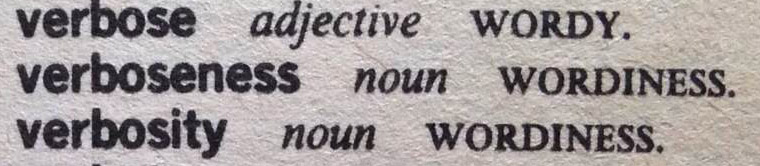
“Not feeling particularly verbose, she replied with only a nod of her head.”
Verbose – adjective
1): containing more words than necessary : wordy ; also : impaired by wordiness
2): given to wordiness
~ per Merriam-Webster
I learned this week that there are different levels to the dreaded Writer’s Block.
Somehow or another, after a solid six months of writing non-stop, I finally hit my burn-out stage this weekend. No, really, when I say non-stop, I mean it. I’m either asleep, at work, or writing since last September. Sometimes I’m all three at once, which is disturbing, but cellphone notepad apps are really useful and portable. This time, though, even the coffee has failed me. I have been working on this project for half a year. I’m at the end of it now and the home-stretch is in sight and… every idea I had for it just flew out the window. I’ve been working at it all weekend anyway, mostly doing editing. I want to write, but the ideas just aren’t there and I end up with disjointed words on the page. I can’t walk away from the project when it could be literally one scene away from being complete.
There’s just that one, tiny, miniscule little detail: I can’t figure out what comes next.
My usual response to this is to put the project down and go do something completely unrelated to writing. Clear the mind. Pull in some new creative inspiration. Catch up on some TV. But this is the last section of the project. I want it done. I want the little bird to fly and leave the nest. I’m impatient to move on to the next big idea. Self-imposed pressure to finish the project is conflicting with the ideas for the new project. But it’s like in gaming and I can’t level up to the next idea until I beat this boss-fight.
Multitasking on projects is a very important skill, the ability to be flexible and to “diversify” the project load and everything. This would be the exact scenario to illustrate that argument. It is obviously a skill I have yet to learn and will continue to work on. So I’m just going to keep throwing words at the page until something sticks.

This word is ridiculously poetic and it caught my attention. I’m sure I must have heard it before, but I didn’t remember it. According to the Google graphic on the word, it was at its heyday around the year 1900, which sounds about right to me.
“Who would have expected a chance meeting in an adult bookstore could be the dayspring of a new career.”
Dayspring – noun
1) archaic : the beginning of day : Dawn
2) the beginning of a new era or order of things
~per Merriam-Webster
A picture says a thousand words, right? But what about music? Sometimes music has lyrics to paint pictures, other times you have notes to follow instead. What’s your musical genre? What story does your favorite song tell you? Is that why it’s your favorite? Music is important, even to writers, just because it’s another form of creative expression. It is communication, too. (And, incidentally, the flow of words in song lyrics or poetry is a good teacher for writers. They can influence how a writer uses their words and how their voice comes through on the page.)
So for a writing exercise, go through your music library and find a song to write to. Just one song. Think about the order of the words in the song, why they were put in that order. Think about the images the song uses; are they effective? What do you see when you hear the song? If there are no lyrics to prompt those images, why do you think the music draws those images out for you? Do you see anything in your imagination at all because of it? Do a free-write, just for the space of that song, while thinking about that song. Repeat the song if you get on a roll.
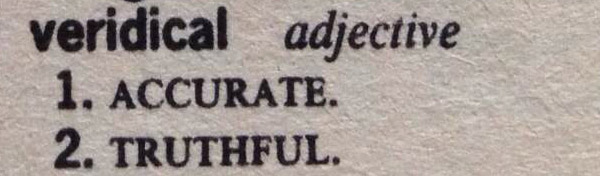
Yup, that’s right folks. Veridical. That isn’t a misspelling, despite how angrily my auto-correct is trying to fix it. Personally, I think it falls under the category of “Words Not to Use” because it will very easily throw a reader out of a sentence if they’re any good at spelling.
The origins of the words are, of course, Latin: verus (true) and dicere (to say.) I would truthfully say this word should be used with caution in any non-scientific work.
“The second witness seemed veridical and forthcoming with his retelling of events.”
Veridical – adjective
1) truthful, veracious
~ per Merriam-Webster