Author: yvonneharbison

  • Writerly things… Like Writer’s Block

    I learned this week that there are different levels to the dreaded Writer’s Block. 

    Somehow or another, after a solid six months of writing non-stop, I finally hit my burn-out stage this weekend.  No, really, when I say non-stop, I mean it.  I’m either asleep, at work, or writing since last September.  Sometimes I’m all three at once, which is disturbing, but cellphone notepad apps are really useful and portable.  This time, though, even the coffee has failed me.  I have been working on this project for half a year.  I’m at the end of it now and the home-stretch is in sight and… every idea I had for it just flew out the window.  I’ve been working at it all weekend anyway, mostly doing editing.  I want to write, but the ideas just aren’t there and I end up with disjointed words on the page. I can’t walk away from the project when it could be literally one scene away from being complete.

    There’s just that one, tiny, miniscule little detail: I can’t figure out what comes next.

    My usual response to this is to put the project down and go do something completely unrelated to writing.  Clear the mind.  Pull in some new creative inspiration.  Catch up on some TV.  But this is the last section of the project.  I want it done.  I want the little bird to fly and leave the nest. I’m impatient to move on to the next big idea.  Self-imposed pressure to finish the project is conflicting with the ideas for the new project.  But it’s like in gaming and I can’t level up to the next idea until I beat this boss-fight. 

    Multitasking on projects is a very important skill, the ability to be flexible and to “diversify” the project load and everything. This would be the exact scenario to illustrate that argument.  It is obviously a skill I have yet to learn and will continue to work on.  So I’m just going to keep throwing words at the page until something sticks. 

  • Word of the Day: Dayspring

    This word is ridiculously poetic and it caught my attention.  I’m sure I must have heard it before, but I didn’t remember it.  According to the Google graphic on the word, it was at its heyday around the year 1900, which sounds about right to me.

    dayspring“Who would have expected a chance meeting in an adult bookstore could be the dayspring of a new career.”

    Dayspring – noun

    1) archaic :  the beginning of day : Dawn

    2) the beginning of a new era or order of things

    ~per Merriam-Webster

  • A writing prompt to focus the coffee rush

    Image

    A picture says a thousand words, right?  But what about music?  Sometimes music has lyrics to paint pictures, other times you have notes to follow instead.  What’s your musical genre?  What story does your favorite song tell you?  Is that why it’s your favorite?  Music is important, even to writers, just because it’s another form of creative expression.  It is communication, too.  (And, incidentally, the flow of words in song lyrics or poetry is a good teacher for writers. They can influence how a writer uses their words and how their voice comes through on the page.)

    So for a writing exercise, go through your music library and find a song to write to.  Just one song.  Think about the order of the words in the song, why they were put in that order.  Think about the images the song uses; are they effective?  What do you see when you hear the song?  If there are no lyrics to prompt those images, why do you think the music draws those images out for you? Do you see anything in your imagination at all because of it?  Do a free-write, just for the space of that song, while thinking about that song.  Repeat the song if you get on a roll.

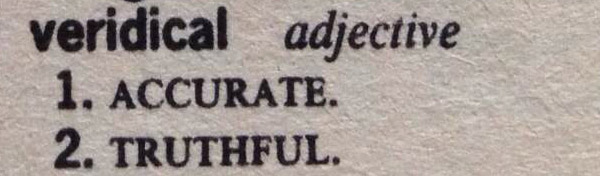
  • Word of the Day: Veridical

    Yup, that’s right folks.  Veridical.  That isn’t a misspelling, despite how angrily my auto-correct is trying to fix it.  Personally, I think it falls under the category of “Words Not to Use” because it will very easily throw a reader out of a sentence if they’re any good at spelling.

    The origins of the words are, of course, Latin: verus (true) and dicere (to say.)  I would truthfully say this word should be used with caution in any non-scientific work.

    verdical

    “The second witness seemed veridical and forthcoming with his retelling of events.”

    Veridical – adjective

    1)  truthful, veracious

    2)  not illusory :  genuine

    ~ per Merriam-Webster

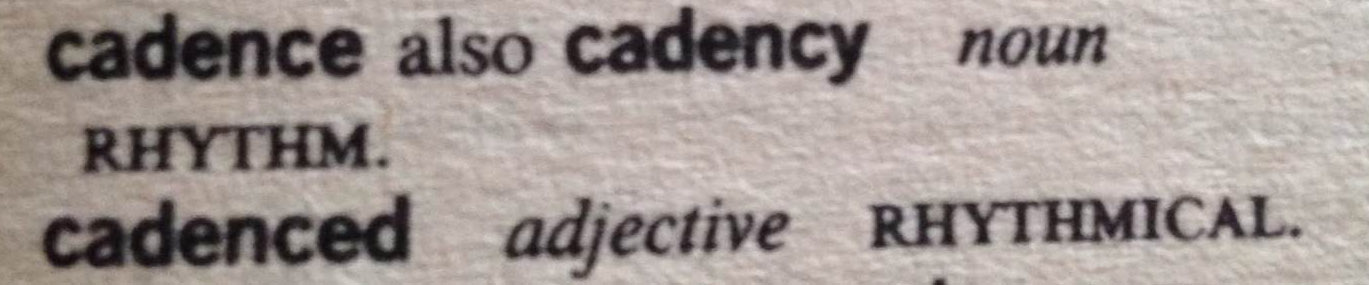
  • Word of the Day: Cadence

    Vocabulary is a writer’s best friend.  Mine is sadly lacking.  (My grammar is worse, but my vocab list is pretty short.)

    So! Here’s a word to think about today, maybe use it somewhere if it’s useful.

    cadence“The cadence of her footsteps on the marble flooring heralded trouble on the way.”

    Cadence: noun
    1)
    a :  a rhythmic sequence or flow of sounds in language.
    b :  the beat, time, or measure of rhythmical motion or activity

    2)
    a :  a falling inflection of the voice
    b :  a concluding and usually falling strain; specifically :  a musical chord sequence moving to a harmonic close or point of rest and giving the sense of harmonic completion.

    3)  the modulated and rhythmic recurrence of a sound especially in nature.
    ~per Merriam-Webster
  • Writerly things… like Characters

    Ah, characters. The good guys. The bad guys. The goofy sidekicks. The random passerby in the background. These are the bread and butter of the storyworld, the main staple that feeds the craft. They don’t always have to be human in some medium to still get the stories across and there can be stories without characters.  It’s not recommended, though, because the audience wants to know who to cheer for. For that you need characters to choose from.

    Besides, creating characters is the fun part! What makes them unique?  What makes them a product of your imagination?  Even characters who are based on “real life” individuals have to be run through the imagination of the writer before they can be put on the page.  There’s always details that just won’t fit with the story the author wants to tell, from dialogue between characters to hair color to the preferred brand of booze they have while lamenting their broken homes. That’s all stuff the writer gets to make up and build stories around.

    Part of that is looking at the way real people actually work.  It does no good to tell a story where everything is perfect and no one screws up because everyone is flawless.  The audience starts to feel a bit like they’ve just stepped in amongst the Stepford Wives Club and they immediately want to leave; there’s no one they know there, there’s no one they recognize or identify with.  The story can be lost because the audience looses interest.

    The other problem point to the perfect-character is that a good story needs tension and perfection is the opposite of tension.  The Perfect World is the world where no one wants anything.  Tension is the result of a character wanting or needing something that they can’t easily obtain, there’s a conflict because something is in their way.  This is also something we as writers can borrow from “real life” in the creation of our characters.  We can build this conflict into the character’s past and we can use that to steer the plot.

    Character and plot are actually related more than we immediately notice as an audience; what makes a character unique is that they can’t be plug-and-play inserted into any story, we have to give them their story for this reason.  What do they want? How would they respond to a given situation?  Their past experiences and their present needs steer the answer to those questions and the answers to those questions should ultimately show how the plot unfolds. A writer has to dabble in a little psychology to play in creating characters and explore the idea of “universal needs” and how those impact people in their day to day lives when they go unfulfilled.

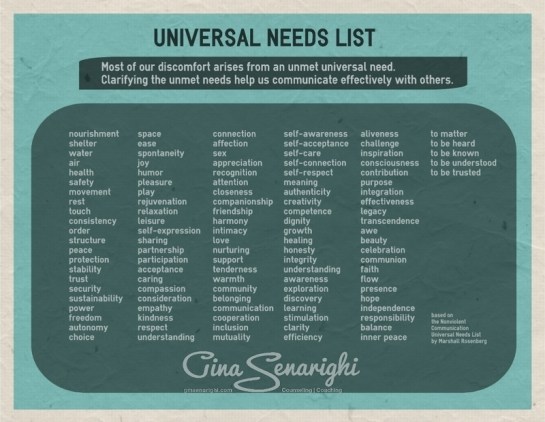
    Blogger and counselor Gina Senarighi compiled a useful list of examples of Unmet Universal Needs that impact how people communicate with each other in the real world. (It’s an interesting article, too, so check it out!) The list applies just as well to the fictional world.

    Universal_Needs_-_Creating_Characters
    Image copyright Gina Senarighi.

    Just as an exercise, go through this list of “Unmet Universal Needs” and see what kind of character traits jump out at you.  What can you build from them? A whole novel? A short story? Or just an interesting background/support character?  Every character you put on the page deserves the same amount of attention in their creation, because you never know if they’ll come in handy later while you’re writing!

  • Some Thoughts on Storytelling

    I found this great article, “What Makes a Really Good Story?” by Ted Albrighton, that looks at storytelling through the lens of commercial use.  You don’t often think about commercials as “stories” because, in theory, you know they’re trying to sell you something, not to entertain you.  Stories come with this connotation that they are how we “waste time” and check out of reality.  We don’t often think of them as valid forms of communication and a tool set to be relied on; if we did, getting an English degree wouldn’t have resulted in my hair-dresser telling me I wasted my money and should have gone for a business degree like she did.  Storytelling is a business, it has a function, people can profit from it if that is their goal in life.  Storytelling has been around as long as mankind; it wouldn’t have survived that long if it didn’t have a purpose. The marketing world is tapping into that.  So, buyer beware, they’re looking to lure you in with stories. And it will work, hook, line and sinker.

    The one thing I dislike about this article is the very narrow focus they have on what constitutes a story. A story is anything that gives you something to follow to a conclusion. One of the best examples of this that I’ve ever heard is “I threw the ball. It bounced. You caught it.”  That has a beginning, middle and end.  It evokes engaging images. It has characters. It is the movement of information from one source to another. Nine words made a story. Six words can tell just as effective a story; I’m sure you’ve heard of “For sale: Baby shoes, never worn.” largely attributed to Hemingway. Did I just sell sports equipment or baby shoes? No. But they were stories. So my caution here is to not get caught up on formulas of what works or what defines a story, because there are an endless variety of ways to craft a story. The only one that’s “the right way to do it” is the one that eventually gives you a product you’re satisfied with.

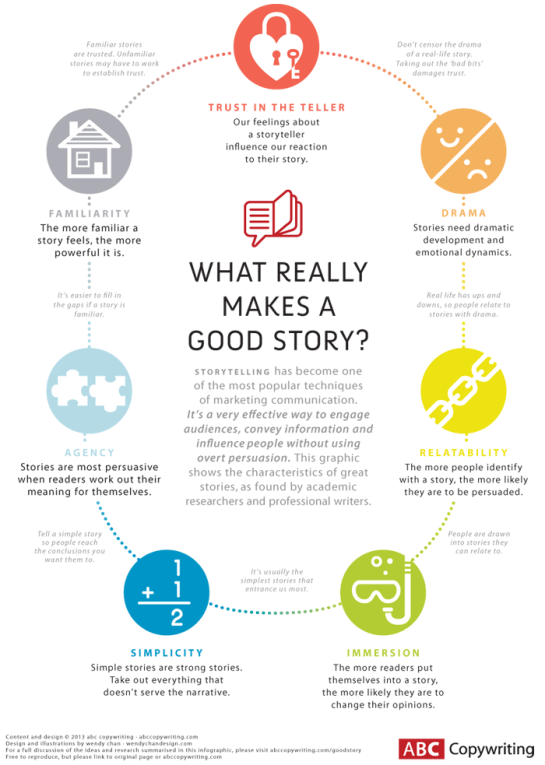
    The article has this really useful infographic that breaks down traditional storytelling in an easy to follow fashion, but with the focus being instead on what will sell.

    Image copyright ABC Copywriting.  See the link!
    Image copyright ABC Copywriting. See the link!

    If you’re in advertising, this is useful.  If you’re looking to be published, this is also really useful! Publishing is sales, because people have to buy the work you publish. So in that sense, the graphic gives you some “insider” perspective on what’s most important and why.  In terms of just a writer, sitting down to put words on the page and get their story drawn out of their brain in the most logical, understandable way, this is still useful because it is relying on the recognized elements of a story. The article goes into more depth on them, but is focused on the marketing perspective to the point of distraction.

    Look through it, add your own, come up with your own “writing rules” to live by.  There is no such thing as a “proper” story.  It’s yours, so tell it how you wish!


  • Five Reasons to Write with Coffee In Hand


    Image

    Coffee is a necessary evil.  (And, horrifyingly enough, it is subject to the whims of the climate just like every other food supply.)  Sure, there’s always tea, but it’s just not the same. Coffee and writing go hand in hand for me, no matter the time of day.  Coffee is the most important thing in a writer’s arsenal.

    First, coffee is a multi-sensory experience.  You walk into a coffee shop – or within a block of a good one – and you can already smell it.  Just walk by the coffee aisle of a grocery store.  It draws you in, it makes you take a deep breath and just exist there for a moment. Tea is nowhere near that strong an aroma. Only coffee can follow you around. Then you get a nice warm mug in your hand, you can feel the heat on the pads of your fingers, soaking into your palm, and it just radiates pleasantly up your wrist.  The first taste of the brew is sometimes lost to the heat if you’re not careful.  But then, there it is. Light or dark, caff or decaff, a hint of chocolate, maybe some creamer, whatever your flavor, it has a taste just as strong as the aroma.  The senses are engaged. The senses play with the mind, they play with your memories. You’re going to remember that later.  As a writer, that’s obviously important.

    Second, coffee has caffeine.  It is a stimulant.  It’s good go-juice.  So far, it’s even still legal.  A good pot of coffee will get you through those long hours at the computer keyboard or hunched over the notebook.  It will not read over your shoulder, it will not ask you to critique a new idea, and it will not derail your train of thought with small-talk.  It will just sit there, patiently waiting to push you through.

    The third reason coffee is a writer’s best friend is that it can be enjoyed hot or cold. If you let it sit there patiently long enough, it will fade to room temperature and then nose dive into a cold drink.  Add some ice, shake it up a little, and you have an afternoon boost.  A soda gets flat.  Tea snobbishly demands to be microwaved or watered down with a new round of hot water.  Coffee can be tossed in a blender and enjoyed as a chilled alternative.

    Fourth, when you spill coffee, you can see exactly where every sticky drop ran off to.  And you know you’re going to spill it. At the most inopportune time, in the worst possible place, there will be a coffee ring on important papers.  There will be a flood licking the edge of the notebook and a cascading coffee-fall onto the keyboard.  Swear at it, calm down, grab a paper towel and soak it up.  It adds character to those papers, leaves a scent-stamp when it dries.  Tea or soda just gets things wet, and half the time it’s clear liquid and you’ll be finding the trail until it evaporates.  Coffee stays classy and always leaves it mark.

    And, last but not least, coffee is habit-forming. It encourages routine, which all good writers recommend. Currently, coffee is a cheaper and healthier writing-habit to form than something like alcohol.  Yes, the bottle will always be there to listen, I say sarcastically, but in all seriousness, the long term damage just isn’t worth it.  Ask Hemingway, among others.  And as a bonus plot twist, coffee may actually be good for you!

    So next time you head for Starbucks or the corner cafe, smile and know you’re on the right track.

  • Cover Letters and Job Hunting

    I’ve been writing for as long as I can remember and still find writing letters that begin “To whom it may concern” very tedious.  It’s not very engaging wordplay.  It’s boring.  It’s a business-world casualty hit to the writing voice.  But there it is, because formula is sometimes important.

    However, this is the emerging world of new media.  Rules are changing.  So If I get a vote, I vote that one’s the first to go.

  • Writerly things, with a Blogging Bent

    I am brand new at blogging.  Sure, I’ve been on the internet since the dawn of time.  (Okay, not actually that long, but I once ran up a $100 AOL dial-up bill, and I can imitate the sound of a modem.)  I have done my turn on Twitter, and Livejournal, and Facebook, and tumblr, and ohmygawd I remember myspace.  But blogging with the intent to communicate is a new thing I’m still trying to get the hang of.

    So when a friend pointed me to Single Dad Laughing’s “100 things I Never Expected to Learn Blogging” I pounced on it, because I have yet to meet a SDL post that I didn’t like.  And then, as I read it, I realized some of the concepts behind the points on the list are applicable to all writing.  All forms of publishing or broadcasting or idea-sharing.  Not just blogging.  And, as always, SDL has a helpful reminder to be nice to yourself as a content creator, such a novel idea!  So it’s a nice handy list to have in mind.

    It still gets down to an axiom preached by many people, lately most notably by Dean Winchester and Wil Wheaton: Don’t be a Dick.  Especially not on the internet.