
If you’ve been working in content for any length of time, you’ve had the conversation. A client mentions SEO in a brief. A job listing requires “SEO experience.” A coworker talks about keywords like they’re a secret language. Everyone seems to assume you either know what they mean or you’ll figure it out.
And maybe you have figured it out. In pieces of it, over time, from context and trial and error. But there’s a difference between picking up SEO vocabulary on the job and actually understanding what SEO is and how it works. That difference matters more now than it did five years ago, and if you work in content, it’s worth closing the gap ASAP.
As someone who has been on this roller-coaster for a decade with coworkers and friends and fellow writers, I can help with this fun experience. Let’s start from scratch.
The Literal Definition (and Why It Doesn’t Help Much)
SEO stands for Search Engine Optimization. Technically, it refers to the practice of improving a website or piece of content so that search engines rank it higher in their results.
That definition is both accurate and almost completely useless if you’re trying to understand what SEO actually involves or why it matters to you as a writer. Today’s SEO is completely different than it started out. The playing field now includes AIO and GEO on the same team as our SEO star.
For the Ted Lasso fans out there: think of SEO as Roy Kent in his post-retirement coaching era. He knows the pitch better than anyone on the roster. AIO and GEO are the flashy new signings who are full of energy, unproven under pressure. Roy doesn’t get replaced. He’s one of the Diamond Dogs, the captain who becomes a coach. He’s the reason the new players actually perform. That’s the relationship SEO has with the newer tools: foundational wisdom coaching the shiny new arrivals, not competing with them.
Here’s a perhaps more useful definition: SEO is the practice of making your content findable by the people who need it.
At its core, that’s the whole thing. When someone types a question into Google, Google’s job is to return the most useful, credible, relevant answer it can find. SEO is the discipline of making sure that when your content is the best answer to a question, Google can find it, understand it, and surface it.
That framing changes the relationship between writing and SEO. It’s not about manipulation. It’s not about tricking an algorithm. It’s about making genuinely good content legible to the systems that connect readers to information.
How Search Engines Actually Work
I don’t want to go into a technical deep-dive here, but a basic understanding of what Google is doing changes how you think about your work. Here’s the short version:
Crawling. Google uses automated programs called crawlers (sometimes called bots) to continuously explore the web. They follow links from page to page, discovering new content and revisiting existing content.
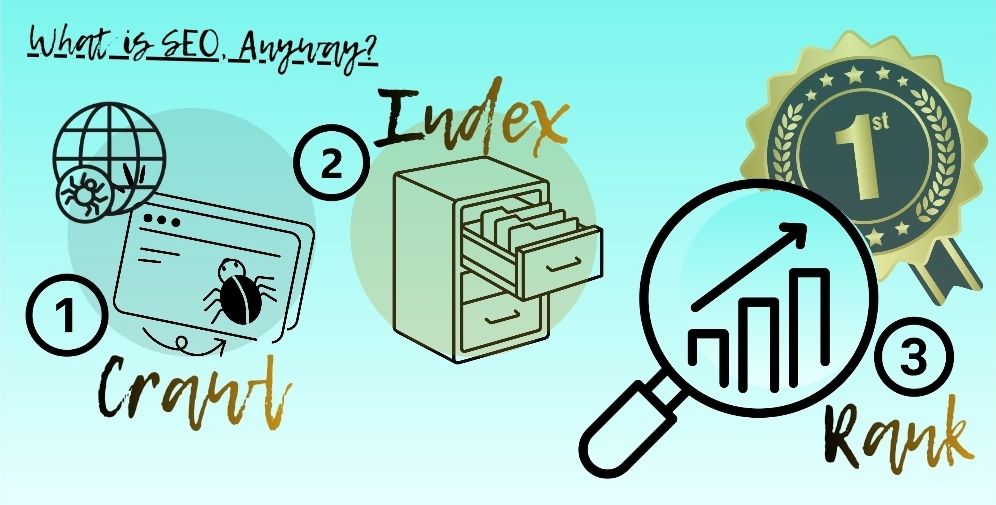
Indexing. When a crawler visits a page, Google processes it and stores information about it in a massive database called the index. This is Google’s map of the web. If a page isn’t indexed, it won’t appear in search results and it effectively doesn’t exist, as far as Google is concerned.
Ranking. When someone searches for something, Google’s algorithm sorts through the indexed pages and ranks them by relevance and quality. This is where the real complexity lives: Google uses hundreds of signals to determine which pages deserve to rank for which queries.
The ranking part is what most SEO work is focused on and what most SEO advice is about. But it helps to know that the foundation is simple: can Google find your content, understand it, and connect it to the people looking for it?
What Google Is Actually Trying to Do
This is the piece that most SEO explanations skip, and it’s the most important one.
Google is not neutral. It’s a business, and its business model depends on people trusting its search results enough to keep using it. When you type a question into Google, you’re relying on it to return a genuinely useful answer, not a page that has been cleverly optimized to appear useful while delivering very little. (The latter approach historically didn’t work out well for searchers and caused Google to do some major overhaul on their algorithm choices somewhat early on.)
Google’s goal is to return the best answer to every query. Everything in its algorithm is aimed at that goal. The reason Google rewards E-E-A-T signals (experience, expertise, authority, trustworthiness) is that it’s trying to identify content backed by real knowledge.
Aside from being less informative in general, keyword stuffing the content is usually worse for readers. Google also rewards clear structure and fast load times because these things make content more usable. User experience is important, and, on top of that, often hard to predict.
This is important for writers because it means that good writing and good SEO are, at their best, aligned. When Google rewards specific, credible, clearly written content, that’s a description of good work. In theory, the craft and the optimization point in the same direction.
That hasn’t always been true, and it’s not universally true now. After all, the search algorithms exist in an unknown, mystical Black Box; we don’t know every criteria to target and have to test and iterate. There are still some folks in SEO who prefer gaming the system rather than improving the work. But the broad direction of search, over the past several years, has been toward rewarding content that is genuinely worth reading.
The Three Pillars of SEO
Most SEO work falls into three broad categories.
Technical SEO is about the underlying infrastructure of a website. Bots assess whether it loads quickly, whether it’s set up so Google can crawl and index it properly, whether it works on mobile, whether it has proper security certificates, and other markers. Technical SEO is mostly not a writer’s job, but it’s good to know it exists. If you ever publish excellent content that gets no traffic, technical issues are one of the first things worth checking.
On-page SEO is about the content itself — the words, structure, headings, metadata, internal links, and other elements on each individual page. This is the pillar most relevant to writers, and it’s where most of your attention should go.
Off-page SEO is about signals that come from outside your own site, primarily looking at who links to you. When credible websites link to your content, it signals to Google that your content is trustworthy and authoritative. Building these links (called “link building” or “earning backlinks”) is a significant part of SEO strategy at the site level. As a writer, you’ll mostly encounter this in terms of why it matters to publish in credible places and to have your work associated with reputable sources.
Why This Matters Specifically to Writers
SEO knowledge makes you more valuable and more effective, in ways that compound over time.
If you freelance, understanding SEO means you can have more sophisticated conversations with clients about content strategy. You can evaluate a brief and know whether the approach is likely to work. You can push back intelligently when a client asks for something that won’t serve the actual goal. Writers who understand SEO are consistently paid more for the same work, because the work is genuinely more useful.
If you’re building your own platform, whether a blog, a newsletter, or a personal site, SEO is what determines whether content you’ve worked hard on actually finds readers. Publishing into the void is discouraging. Understanding how to help your work get found changes the whole equation.
And if you work in-house, SEO literacy means you can be a real collaborator with your SEO team rather than someone who receives keyword lists and doesn’t quite understand what they’re for.
None of this requires you to become an SEO specialist. It requires a working understanding of how the internet works, thinking carefully about how it applies to your work, and practicing.
Good Writing Deserves to be Found
SEO is not what you do instead of writing well. It’s what you do to make sure the good writing gets found.
The writers who struggle with SEO tend to treat it as a separate task, like something to layer onto content after the real work is done. The writers who thrive with it treat it as part of how they think from the beginning: who is looking for this, what are they actually trying to find, how do I make sure what I’ve written is the clearest possible answer to that question?
That integration doesn’t happen overnight. But it starts with understanding what SEO actually is.
Now you do. Let’s keep going.


Leave a Reply