What Is Content Strategy
“Content strategy” is one of those terms that gets used so loosely it’s almost stopped meaning anything.
In some organizations, it describes a planning document, renewed and reviewed every month and every quarter. In others, it’s what the marketing manager calls her thinking process when she decides what to post on Instagram. In still others, it’s a full discipline with its own practitioners, its own methodology, and its own career path, one that pays significantly more than “content writer” on most salary scales.
If you’ve worked in content for any length of time, you’ve probably run into all three versions. You may have been handed a “content strategy” that was actually just a calendar, or sat in a meeting where “strategy” described a vague topic list someone put together the night before.
I’ve been trying to nail down a more useful definition, one that actually holds up across contexts. Here’s what I landed on, and why I think it matters specifically to us.
A Working Definition
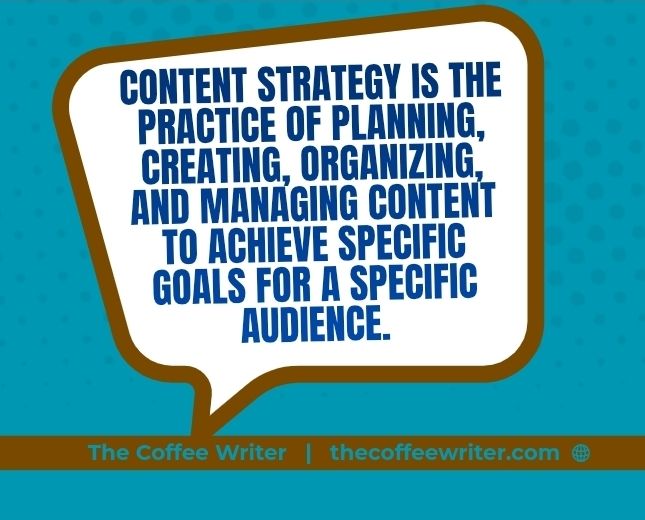
Content strategy is the practice of planning, creating, organizing, and managing content to achieve specific goals for a specific audience.
Every word in that definition is important here.
It is not just creating art for the sake of art, or writing out social posts to meet a specific calendar schedule. The art will be created anyway, the written posts will be shared eventually, and those are very different than something that is a “strategy.”
Planning means decisions happen and are documented to be shared before production, not during it. Good content strategy doesn’t start with “what should we write today?” It starts with documented answers to harder questions:
- Who are we writing for?
- What do they need?
- What are we trying to accomplish?
- And how will we know if it’s working?
Creating is where we live. It’s the actual work of compiling knowledge, experience, preferences, and judgment calls. The thousand small decisions that go into taking an idea to a finished piece someone can actually read. Creation doesn’t exist in a vacuum, though. It’s informed by the planning that came before it. The work isn’t just good writing; it’s good writing aimed at a defined purpose.
Organizing is about structure: how content is categorized, how pieces relate to each other, how a body of work is meant to be experienced versus how a reader actually moves through it. This is where content architecture, hierarchies, and series structure all live.
Managing is the ongoing work that surrounds the content, like maintaining the content over time, updating what’s become outdated, retiring what no longer serves its purpose, and continuously calibrating what gets produced and why.
“To achieve specific goals” is the part that separates strategy from a content calendar. Strategy is always in service of something. Awareness. Conversion. Retention. Authority. Trust. Without a defined goal, you’re just publishing.
“For a specific audience” is the constraint that makes strategy useful. Content aimed at everyone serves no one particularly well. Strategy requires knowing who you’re writing for and making deliberate decisions accordingly so that we can meet the reader where they are.
Content Strategy Is Not Content Writing
Content writing is a practice. Content strategy is a discipline. They’re different steps in a combined process. They’re related, but they require fundamentally different kinds of thinking, different creative muscles that work in concert but aren’t the same muscle.
Content writing asks: how do I write this piece as well as possible?
Content strategy asks: should this piece exist? Who is it for? What should it accomplish? How does it fit with everything else we’ve published or plan to publish? How will we know if it worked?
A writer can be excellent at their craft and never ask those questions. In a well-resourced team, someone else is asking them and then translating the answers into creative briefs that inform what we create. That’s a helpful and efficient division of the creative labor when it exists.
But most of us work without that infrastructure. Many times, the writer is asking the questions during the planning stage, before the content is written, and then proofing their work against the questions afterwards. Most freelancers do that work on our own. Plenty of in-house writers do, too. When the strategic scaffolding isn’t there, those questions don’t disappear. They just go unasked and the content suffers for it.
Writers who develop strategic thinking don’t stop being writers. They become writers who understand why they’re doing what they’re doing. In my experience, that shift changes the quality of the work more than almost anything else.
Content Strategy Is Not Content Marketing
This distinction trips people up, because the two genuinely overlap.
Content marketing is a marketing approach that uses content to attract and retain an audience, with the ultimate goal of driving that reader toward becoming a customer. It’s defined by its purpose: marketing. Content is the vehicle; acquisition or retention is the destination.
Content strategy is broader. It can serve marketing goals, but it can also serve editorial goals, community goals, educational goals, brand goals or any number of other purposes. A content strategy for a medical information site is not content marketing. A content strategy for a literary magazine is not content marketing. The strategy I’ve built for The Coffee Writer is focused around community and knowledge-sharing, not customer acquisition in any traditional sense.
Most of us spend our days working in contexts where the two overlap significantly, from brand blogs, to company websites and digital publications. But the distinction matters because it shapes what “success” looks like.
- If the strategy is marketing-oriented, success looks like lead generation and conversion.
- If it’s oriented toward authority and community, success looks like return visits, engaged readers, and a reputation that compounds over time.
Knowing which goal you’re serving changes the decisions you make.
Why Writers Are Actually Good At This
Here’s the part I find genuinely encouraging: writers aren’t just capable of doing content strategy. We have specific advantages that other roles on a creative team often don’t.
We understand language at a granular level. Maybe I’m an odd duck, but I have internalized English sentence structure and use it instinctively, in creative ways. We know how word choice affects perception, how structure affects comprehension, how tone affects trust. Those aren’t abstract skills in a strategic context, either! They’re directly applicable to every decision about how content should be framed, structured, and sequenced.
We understand what it actually takes to make content. Strategic plans that don’t account for production realities, that wildly overestimate output, or assume all content types require the same time and effort… those will fail in execution every time. We know better, because we’ve lived. We research, we observe, we learn the context around the things we write about in order to frame things accurately. That same instinct for realistic scope is exactly what strategic planning needs.
We understand the reader. Strategy is ultimately about serving an audience. We spend our professional lives trying to understand what a reader needs and how to deliver it. That orientation isn’t something we have to develop from scratch. It’s already built in.
What This Means in Practice
Recognizing and developing our strategic literacy changes our work as modern writers in concrete ways.
It changes how we evaluate briefs. When a brief lands in my inbox, I’ve started asking the questions a strategist would ask: who is this for, what’s it supposed to accomplish, how does it fit with what else is being published?
Those questions surface problems that would otherwise cost hours of revision, or worse, create a finished piece that doesn’t serve the goal it was supposed to serve. A good brief will have those questions answered directly, but it’s a rare thing to find a good creative brief in these days of rush-rush-rush.
It changes how we have client conversations. Writers with strategic literacy can participate in conversations that go beyond “what would you like me to write?” We can identify when a client’s content problem isn’t actually a content problem, or when the brief we’ve been handed won’t solve the problem they think it will.
It changes how we build our own work. Whether you’re developing a platform, a portfolio, or a freelance body of work, strategic thinking helps you make deliberate decisions about what to create, who it’s for, and what you’re building toward.
It changes what we’re worth. Writers who bring strategic thinking to their work are worth their higher rates and more interesting assignments. Strategy is a distinct skill, separate from the writing itself. If the client or organization isn’t providing that strategic guidance through the brief, and you’re supplying it anyway, that deserves recognition and compensation..
Think First, Then Write
Strategy is not necessarily a document. It’s a way of thinking about and sharing that process in a productive way.
The most useful thing I’ve found isn’t a set of templates or frameworks. It’s a set of questions that have become habitual, things I ask at the start of every project, every content decision, every round of planning.
- Who is this for?
- What do they need from it?
- What are we trying to accomplish?
- How does this fit with everything else?
- How will we know if it worked?
Ask those questions consistently, and you’re doing content strategy, regardless of whether you call it that.


Leave a Reply